

ADVOCATE FOR CHEQUE BOUNCE CASES AT AFFORDABLE AND REASONABLE RATES IN ANDHERI EAST
WHAT IS CHEQUE BOUNCE:
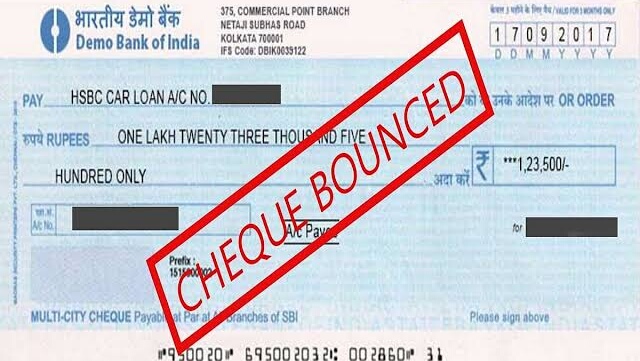
when a cheque is presented in the bank, it is cashed and the amount is deposited in the account of the stipulated person. But under certain circumstances, when the cheque gets returned unpaid, it is said to be dishonored or bounced. This could happen due to a variety of reasons such as insufficiency of funds, signature mismatch etc. When a cheque bounces, the bank issues a ‘cheque return memo’ with the reasons for non-payment mentioned alongside.
The person who writes the cheque is known as the ‘drawer’ and the individual in whose favor the cheque is written is called the ‘drawee’.Cheques are mostly preferred due to the security it offers as compared to other forms of money transfer such as NEFT (National Electronics Funds Transfer). A crossed cheque for instance cannot be cashed by any person other than the payee and it will be deposited in the payee’s account only.
WHAT ARE THE REASONS FOR CHEQUE BOUNCE?
· Insufficient balance in the account of the person who is writing the cheque.
· Signature of the drawer (person who writes the cheque) is unclear or erased or incomplete or fraudulent.
· The account number is written on the cheque if not discernible with the naked eye.
· Overwriting has been done on the cheque.
· If the account from which the drawer wants to take out money does not exist.
WHAT IS TH APPLICABLE LAW FOR CHEQUE BOUNCE?
Sections 138 to 142 of the Negotiable Instruments Act is applicable in a Cheque Bounce case. These sections are penal provisions that are there to make sure that the obligations which the drawer of the cheque has towards the payee are honored to the fullest extent. The ingredients that are required to be fulfilled under section 138 are-
· A person must have written a cheque in favour of another person in furtherance of money that the person owes to another.
· The payee (the person in whose favour the cheque is drawn) has to approach the bank for the payment via the cheque within three months.
· The bank returns the cheque without any payment because of any of the reasons mentioned above.
· The payee then has to send a legal notice to the drawer demanding payment of the money.
· The drawer does not pay the required sum of money
PROCEDURE FOLLOWED IN SECTION 138 COMPLIANTS FILED IN MAGISTRATES’S COURTS.?
1. If the drawer does not pay the money within 15 days after the legal notice has been sent to him, the payee can file a criminal complaint against the drawer of the cheque in the magistrate court of competent jurisdiction under section 138.
2. If the court is satisfied with the claims made by the payee, then the court calls upon the drawer by issuing a summons.
3. If the drawer refuses to appear in court, then the court can issue a bailable warrant against him.
4. If the accused does not turn up in court even after the issuance of a bailable warrant, the court can issue a non-bailable warrant to secure the presence of the drawer.
5. If the accused pleads guilty, the court sentences him and if the accused pleads not guilty, the accused is given a copy of the complaint made out against him.
6. Both the parties are then cross-examined and they can produce their evidence.
7. The court passes the judgment which is subject to appeal by either party.
WHAT ARE THE DOCUMENTS REQUIRED TO FILE COMPLAINT OF CHEQUE BOUNCE:
· Unpaid cheque slip returned by the bank of the drawee.
· The legal notice which was sent to the drawer.
· The response to that notice
· Invoice
· The original bounced cheque and its copy.
WHAT IS THE PUNISHMENT FOR CHEQUE BOUNCE:
- Imprisonment which can extend to 1 year.
- Recovery of cheque amount or double.
- Both
CAN CIVIL SUIT BE FILED FOR CHEQUE BOUNCE?
A civil suit can be filed by the complainant against the drawer under order 37 of CPC. In such cases, a summary suit under Order 37 of CPC can be filed in a civil court. Such summary suits are only filed in cases of recovery of money etc. a basic difference between a criminal complaint and a civil complaint of cheque bounce is that in the criminal complaint, the drawee wants to recover the amount and punish the drawer for the non-payment but in the civil complaint, the focus is solely on recovering the amount.
WHAT IS THE VICARIOUS LIBILITY OF DIRECTORS OF COMPANIES WHEN A CHEQUE BOUNCES?
The honoring of cheques does not only depend on materialistic factors such as signatures and account holder’s name and insufficient balance but also depends on the credibility of the drawers and their integrity and honesty. Bouncing a cheque can cause a huge amount of loss which is financial and also causes a lot of time wastage of the payee. A company is an artificial legal entity that runs through its owners and directors. When a cheque is drawn by a company bounce, the primary onus doesn’t only fall on the company but also on its directors. Section 141 of the Negotiable Instruments Act talks about offences of the company, which also makes the directors vicariously liable.
WHAT ARE THE RECENT AMENDMENTS TO THE NEGOTIABLE INSTRUMENTS ACT:
- The drawer of the cheque will pay interim compensation to the payee to the tune of 20% of the amount of the cheque.
- The interim compensation has to be paid within 60 days from the date of the order passed by the court.
- If the court finds out that the drawer of the cheque was not responsible for anything and is acquitted, then the drawee has to pay back the compensation with interest.
WHY US :
We have the requisite experience and expertise when it comes to Cheque Bounce cases. As an experienced lawyer we can help you navigate the legal landscape, ensuring that you are making informed decisions that are in your best interest. We can also help you avoid potential legal problems by reviewing contracts, advising on compliance with laws and regulations, and handling legal disputes.
#Documentation #handling legal disputes #Complainces #Consent Terms #Term sheet #Agreements #Contracts #Corporate Advisory Services #Retainers #Power of Attorney #Sale Deed #Negotiations